Monday, July 22, 2019

'Use your damn Privilege' - Quickie on a Tension in Modern Feminism

You've probably seen them.

Almost certainly you have.

Those posts wherein a young lady goes on a diatribe about being catcalled by a random male stranger and, perhaps even physically touched by him.

There was a recent post I saw describing such an event. The woman was catcalled, then touched: first held by the shoulders as she was told she was beautiful, and then touched on the small of her back while this stranger showed her off to his gang of miscreants. It was the touching that made the whole affair noteworthy, as she wrote. Very scummy, indeed.

I have a tendency of skipping such posts since I can only muster so much concern for inconvenient confrontations that are used to pronounce boilerplate feminist rants: which this was. However, what stood out to me was the last sentence: 'Use your damned privilege'. That prompted me to look at the rest of the post.

This plea, or demand, was prompted by the fact that the man who was working the station did nothing to intervene. He just offered some mild condolence, 'I'm sorry you had to put up with that'.

Fair enough.

Now, here is where I think this whole assessment is illustrative of a misguided view that has been taught to young women. This will be a bit facetious. 

First, telling someone that they ought to do something doesn't sound like there is much privilege at play. And what sort of privilege is this? The privilege to stand up to an unknown male on the behalf of an unknown vulnerable female with the risk of engaging in physical conflict? I think the woman has the privilege, here: to call on male protectors to swoop in and defend her honour.

Now, if you ought to do something, that is an obligation. Men, I think, do have an obligation to stick up for women, and I think that obligation arises from the fact that most women, on average, are physically weaker than men. Men, who, on average, are stronger than women, may try to take advantage of women, and other men should protect women from such men. However, this is at odds with what feminism, in its contemporary guise, tells us again and again: that women are independent and interchangeable with men. This demand calls for a recognition of the damsel in distress. By demanding that men intervene, one is recognising that one needs help, particularly from men.

To buttress this claim: I'd ask, 'is this experience typical for women, today?' I would predict an almost certain 'yes', given the rank patriarchy that is supposed to roam throughout the channels, arteries and capillaries of society. There isn't a space, institution, or practice that isn't infected with it. So, either events such as these are common, or not. And if they're common, and women feel like they need men to intervene, that shows that women need the help of men.

Second, modern feminism is constantly critiquing men for 'traditional masculine behaviour', however, some of those characteristics are what is needed in situations like the above. As such, being aggressive, assertive, or adhering to traditional male gender roles isn’t necessarily toxic if done ‘in the right way’ - or at least they aren’t toxic if some feminist or other asks you to engage in them on behalf of the sisterhood. What's more, women, as evidenced by this post, and other articles, require masculine men to protect them from other masculine, though less empathetic, men. Ideally, they'd like to have a more masculine man taking care of business - just to ensure success in the 'intervention' department. 

So there is a tension: if women are capable, they deserve to be independent, particularly of men, and if they are vulnerable, they need to be protected, particularly from men - and yet, of course, by men.

What these feminists want is, in their own weird way, a man who is capable of violence and assurance in the social hierarchy but has that capacity tempered by an ethic of care. Sounds a bit like a traditional man, to me.


Thursday, July 4, 2019

MMIWG - Genocide Postscript


This is more of an suspicious concern of mine. It goes beyond the Report, and to the way it has been used. 

Trudeau holds a copy of the Report presented to him
by the commissioners of the National Inquiry.
When I was listening to the public speeches given at the MMIWG presentation of its Final Report (found here), I couldn't help but feel a sense of subversion. Here we were: witnessing a crowd of people with the Prime Minister sitting in the front row, all listening to the Chief Commissioner speak of her findings. She spoke of the violence and neglect faced by women, girls  and 2SLGBTQQIA Indigenous peoples - the repetition of that acronym is distracting and borders on irritating, as she trips over its clunkiness in attempting to maintain political posture. Then she drops the bomb: 'this is genocide', and the crowd cheers. She smiles and nods in recognition. The Prime Minister applauds, tentatively.

Now, I find the cheers suspect. I don't think they're cheering the fact that a genocide has been uncovered. I don't think they're cheering that their communities have experienced crimes against humanity. I don't think they're cheering their entrance into a club that involved Rwanda, the Holocaust, Indonesia, and myriad other horrible mass murders and targeted exterminations. I think they were cheering the signalling: they're were cheering the fact that they can call Canada genocidal to its face. 

In a recent Leger Poll, 44% per cent of respondents agreed with the National Inquiry's conclusion that the MMIWG situation was an 'ongoing genocide', while 37% disagreed.

Do these folks who agree with the genocide charge understand that there are legal consequences that come with that? Do they understand how serious the crime of genocide is? Do they understand that it is an internationally recognised crime against humanity? Or do these people think it is just some conscious-raising exercise to tacitly accept the term and reflect on it so as to atone for the crimes of their forefathers? Or perhaps even the crimes of other peoples' forefathers?

This wasn't a recognition of the truth: it was a catharsis - and these can be very different things.

Wednesday, July 3, 2019

Canada's 'Genocide': Goldilocks, Family Resemblance & Concept Creep

The Final Report from National Inquiry into Missing and Murdered Indigenous Women and Girls (MMIWG) was announced the other week, and it concluded that Canada had been and continues to be engaged in a 'race-based genocide of Indigenous Peoples, including First Nations, Inuit and Métis, which especially targets women, girls, and 2SLGBTQQIA [Two Spirit, Lesbian, Gay, Bisexual, Transgender, Queer, Questionning, Intersex, and Asexual] people'.

Furthermore, they state that this 'genocide has been empowered by colonial structures, evidenced notably by the Indian Act, the Sixties Scoop, residential schools and breaches of human and Indigenous rights, leading directly to the current increased rates of violence, death, and suicide in Indigenous populations'.

There is a lot to say about the Final Report. Firstly, if they're studying missing and murdered indigenous women and girls, why isn't it a 'femicide' instead of a genocide? Well, because they added the 2SLGBTQQIA acronym, which seems to be an unwarranted expansion of scope, they would have to include men into the report on women and girls. There is also their retroactive treatment of the law, as well as the ambiguity of mens rea, and the way they jump from lex ferenda (or what the law should be) to lex lata (what the law is). Despite these, I'm going to restrict myself to the question: are they justified in their classification of the MMIWG phenomenon as 'genocide'? In doing so, I'll provide the definition of genocide, as well as a schema of common features. I'll then explicate the Goldilocks Problem, and explain the concepts of family resemblance and concept creep as they all apply to the Final Report's claim about Canada being guilty of a present-day genocide.

Definition of Genocide:

According to the UN, genocide means any of the following acts committed with intent to destroy, in whole or in part, a national, ethnical, racial or religious group, as such:
  • Killing members of the group;
  • Causing serious bodily or mental harm to members of the group;
  • Deliberately inflicting on the group conditions of life calculated to bring about its physical destruction in whole or in part;
  • Imposing measures intended to prevent births within the group;
  • Forcibly transferring children of the group to another group.
A part from this definition, there is an instructive format for predicting genocides as they emerge from preceding activities. Created by Gregory Stanton, former Research Professor in Genocide Studies and Prevention at the George Mason University, his 8 Stages of Genocide suggests a series of 'predictable but not inexorable' developmental features of genocide. These stages are listed and briefly described below. 

8 Stages of Genocide:
  1. Classify in-group and out-group – i.e., Hutu from Tutsi;
  2. Create and  impose symbols to identify in-group and out-group – i.e., ID cards or yellow stars;
  3. Exclude out-group from full civil rights – i.e., apartheid or segregation;
  4. Dehumanise out-group – i.e., equate them to animals, vermin or insects
  5. Organise militia and/or special military units for killings - i.e., Janjaweed militia, Schutzstaffel; 
  6. Polarisation via propaganda – i.e., kill moderates, broadcasting hateful propaganda; 
  7. Plans for deliberate killing of out-group are created; members of out-group separated – i.e., land and property are expropriated, forced displacement; and,
  8. Deliberate killing of out-group in mass murder – i.e., often called 'extermination' due to dehumanisation of out-group. 
It is important to note that the UN definition of genocide makes no mention of the word 'State', meaning that the actions do not (necessarily) need to be conducted with explicit governmental support. Additionally, intent is said to be directly proven from statements or orders by the perpetrators, however, more often, it must be 'deduced' from the systematic pattern of their acts, a pattern that could only arise out of specific intent. These 8 Stages would be indicative of such a pattern.

The Goldilocks Problem:

The name refers to the tale of The Three Bears, in which a little girl named Goldilocks tastes three different bowls of porridge and finds that she prefers porridge that is neither too hot nor too cold, but has a temperature that is 'just right'.


For our purposes, the Goldilocks Problem refers to the criteria for demarcation. It asks if our system deemed 'too cold' by ruling-out warranted cases, or is it 'too hot' by ruling-in unwarranted ones? Or is it 'just right'. Now, this effort of demarcation is tougher than one may like. Take 'science', for instance. What counts as a science, and what counts as a pseudo-science? When asked this question, we have to distinguish between what counts as a science and what counts as a pseudo-science in a motivated and non-arbitrary way.  

Now, not every non-science is a pseudo-science: art, engineering and mathematics are not science, but that doesn't mean they're pseudo-sciences since they do not claim to possess the same epistemic status as science for the reasons that science gets that status, whatever those reasons happen to be. 

Pseudo-sciences, however, claim to possess the same epistemic status as sciences for the reasons that science gets that status, and yet does not merit such status. Astrology being a classic example.

I cannot get into the demarcation problem, here, suffice to say that issues, of criteria, merit and status are certain to follow in the discussion on genocide. 

Family Resemblance:

The Principle of Family Resemblance states that things which could be thought to be connected by one essential common feature may in fact be connected by a series of overlapping similarities.

This idea comes from Ludwig Wittgenstein's philosophical analysis of language wherein he explains the plurality of languages via an analogy to the plurality of games.


When you look at what are considered games; games played with balls, cards, sticks, gambling, Olympic tournaments, martial arts, in groups or alone, etc., one notices that there isn’t a single thing that all games have in common, but rather there is a series of relationships that criss-cross to form a constellation of similarities. These resemblances are comparable to the resemblances that members of a family have to one another, hence the ‘family resemblance’:

Concept Creep:
 
Concept creep refers to the expansion of a concept via semantic shift that dilates the original meaning of the term. There are two sorts of expansion: 'horizontal', which captures qualitatively different examples than before, and 'vertical', which captures milder and less severe examples than was originally the case. 

Let's take 'trauma' as an example. This concept has changed significantly; initially it meant severe physical injury, but then the term expanded to include distressing events that were beyond the scope of normal human experience like torture, or being shell-shocked in war. Later on, trauma began to encompass distressing events that occur within the scope of normal human experience like learning about a death or serious injury of a close family member. So here we see the horizontal shift from physical injury to psychological injury, and the vertical shift to include more examples of distress.

Now, words can have fluid meanings, and semantics can shift over time, but it is important to know what a word has commonly meant in order to understand how it has been changed. Sometimes words change for good reason, sometimes they are changed out of good intentions, but sometimes they're changed for political reasons that are not firmly rooted in either. 

Analysis: 

With these concepts in mind, let us look at the features of genocides, past and present, and see what similarities crop up and disappear. Let's make a family. (This list certainly isn't exhaustive, though I tried to incorporate a wider array of examples than the standard - certainly more than are accepted by the Canadian state which only accepts five (5). The list is organised from oldest, to most recent.)


Event
Location
Proportion of population killed *
From
To
Genocide of Indigenous Brazilians
Brazil
38% of all indigenous tribes went extinct
1900
1985
Armenian Genocide
Ottoman Empire
Half of Turkish Armenians
1915
1922
Holodomor
Ukranian USSR
10% of Urkanian Population
1932
1933
The Holocaust
German-occupied Europe
2/3 of European Jewry
1941
1945
Serbian Genocide
Croatia
21% of Serbian population
1941
1945
Cambodian Genocide
Democratic Kampuchea
 1/3 of Cambodians
1975
1979
East Timor Genocide
East Timor
 44% of East Timor population
1975
1999
Rwandan Genocide
Rwanada
70% of the Tutsi population
1994
1994
Darfur Genocide
Darfur
38% of total Fur, Maasalit and Zaghawa tribes' population
2003
Present
Yazidiz Genocide by ISIS
Iraq
Approximately 17% of Sinjar, Irqai Yazidis
2014
Present
* Proportions are the high-end estimates of deaths.

Now that we have this list of genocides, what is common to the phenomenon? Here, I'll apply the 8 Stage of Genocide to see what is found in common. Not all of the above features apply to each of the listed genocides in the same way - how each of the Stages were executed, methods used, etc., vary - but the constellations formed by the genocidal events and their applicable features do show a family resemblance. 

Event
Common Features Present
Genocide of Indigenous Brazilians
1,3,4,5,7,8
Armenian Genocide
1,3,4,5,6,7,8
Holodomor
1,3,5,6,7,8
The Holocaust
1,2,3,4,5,6,7,8
Serbian Genocide
1,3,4,5,6,7,8
Cambodian Genocide
1,2,3,4,5,6,7,8
East Timor Genocide
1,2,3,4,5,6,7,8
Rwandan Genocide
1,2,3,4,5,6,7,8
Darfur Genocide
1,2,4,5,6,7,8
Yazidiz Genocide by ISIS
1,3,4,5,7,8
*This is based on my own research, and I don't intend for it to be scientific or authoritative, but to prove my point about family resemblance. There are certainly more details to be found that could further flesh out this list, and there is some debate about some of the features. I have, however, opted to include the affirm the features under debate, for the purposes of discussion, here.

What we see is that the above examples all share:


(1) Classify in-group and out-group;
(5) Organise militia and/or special military units for killings;
(7) Plans for deliberate killing of out-group are created; members of out-group separated, and;
(8) Deliberate killing of out-group in mass murder


This demarcation is a qualification for what can be considered to be 'genocide'. Has the MMIWG Final Report shown that it has met the qualifications? Is the MMIGW a competitor?

Well, to quote Jules Winnfield from Pulp Fiction, ‘it ain't the same f**kin' ballpark. It ain't the same league, it ain't even the same f**kin' sport.’ That said, I'll try to be charitable to the proponents of the  MMIWG genocide idea.


Event
Common Features Present
Canadian MMIWG
1,2,3,4,6

To obtain the above features, I interpreted:

(1) Classify in-group and out-group: to include the category of Indigenous Peoples/Indian as being opposed to Canadian/Colonial, and colonial history that did demarcate these two groups from one another coupled with the notion that Canadian/Colonial is superior to the Indigenous/Indian;

(2) Create and  impose symbols to identify in-group and out-group: to include government-issued ID cards for 'Status-Indians' under the Indian Act;

(3) Exclude out-group from full civil rights: to include the pre and post-Confederate disqualification from the franchise;

(4) Dehumanise out-group: to include the various assimilationist processes that were imposed upon Indigenous peoples such that citizenship and enfranchisement were contingent on Indigenous peoples relinquishing their traditions and cultures, such as An Act to Encourage the Gradual Civilization of the Indian tribes in this Province (1857), and Residential Schools (1840-1996) which meant to 'to kill the Indian in the child', and;

(6) Polarisation via propaganda: to include (4)

Now, even this is too charitable and was only possible by utilising more radical interpretations of the features that involve concept creep and the historical accrual of past injustices, and going beyond the scope of the MMIWG Investigation.


Family Resemblance, Goldilocks & MMIWG:

Back to Family Resemblance, and the Goldilocks Problem.

We see that the MMIWG phenomenon does share some features of genocide: there is an out-group, it is identified, it had been excluded from full civil rights, and it was subject to dehumanisation and polarisation. The problem is that it also lacks key features that all genocides share: the plans for deliberate killing of the out-group, along with the actual deliberate killing of out-group in mass murder. Now, there is the concept of cultural genocide, and Canada's Residential School system has been described as an example of it - but the MMIWG Report states that the Canadian state has been found guilty of committing a 'deliberate, race, identity and gender-based genocide'. Full stop. With such a strong claim, they don't leave much wiggle room - unless they admit to equivocating. 

Now, there are undeniably problems that Indigenous women and girls suffer: they are five-and-a-half times more likely to be murdered than their non-Indigenous counterparts, and since the 1960s many have gone missing and their cases were never solved. At least 1,181 MMIWG cases exist, and it is certain that there are many more, but even though Indigenous women do disproportionately suffer violence and death, the violence and death isn't existential nor targeted - which is a key component present in the other genocides listed. In fact, the only facets of MMIWG that are close to the 8 Features of Genocide are the assimilationist practices that deprived Indigenous people's of their culture and traditions in (3), (4) & (6). These, however, really collapse into one: the exclusion from full civil rights that was predicated on the belief that Indigenous peoples were not full British subjects by virtue of being Indigenous. This, however, has passed, and has been recognised - and, to my mind is outside of the scope if MMIWG which looks at cases from 1980-2012.

So I conclude that it fails the Family Resemblance Principle. What of the Goldilocks Problem? Is it too cold, too hot, or just right? 

When assessing the MMIWG phenomenon, we don't see it meeting the criteria for genocide without having to expand the understanding of genocide by resorting to politically-motivated tactics, such as piggybacking on past injustices and weaving a seamless tapestry of inter-generational trauma that not only transmits the suffering of past victims to their descendants, but the genocidal intent of past perpetrators - whether they be 'individual masterminds' or the 'burgeoning nation-state' with federalist ambitions, as the Final Report states.  

What we do see, however, is that poor indigenous peoples are suffering from trauma - inter-generational or otherwise - and dying at disproportionate rates with these deaths being ignored by the law enforcement in large part because of the impoverishment of the victims that is predicated on past injustices. But when looking closer, we don't see genocidal intent, organisation and activity. Instead, we see apathetic attitudes of law enforcement, maybe even racist law enforcement, and the faulty belief held by past and present governments that the deaths, murders and disappearances were merely a matter of policing, and not linked to the social ills faced by Indigenous women and their communities.

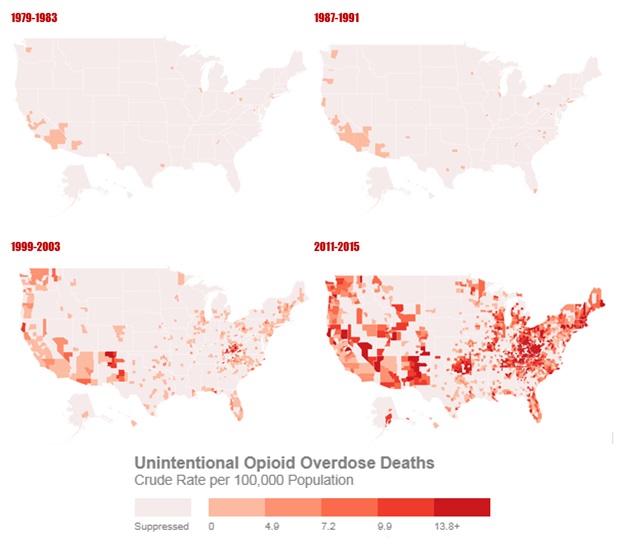
But this is what is being called 'genocide', and if we're to assent to such a claim, then what else are we to call 'genocide'? What other cases are we to consider? A reasonable candidate to my mind could be the Opioid Crisis in the US. 

The Opioid Crisis has killed over a million Americans since the 90’s when the prescription opiate Oxycontin was first released on the market. The history of the Crisis is one of greed, corruption, and indifference embedded in an alliance of private and governmental interests such as Big Pharma, medicine, public institutions and law enforcement that hooked Americans on powerfully addictive drugs, and that let the opioid makers get away with it. 

There is persistent blame and demonisation foisted on the overdose victims, addicts, and their communities - a significant proportion of which are poor working class people, mostly men, and predominately White, though Indigenous Americans face the highest level of addiction.  


Michael Schatman, director of research and network development at Boston Pain Care and editor in chief of the Journal of Pain Research, has even called the Crisis a 'genocide of people with chronic pain'. Talk about concept creep!

But why not consider the Crisis a genocide? Because the victims do not make the right kind of protected class? Then why not expand the classes to be more inclusive? Aren't we supposed to be fighting injustice? Why should we lock them out of the struggle for justice? Or perhaps the population isn't targeted in the 'right way'. 

I'll extend an olive branch, here.

As noted, the history of Canada and its Indigenous people’s has been called a cultural genocide, exercising intent to assimilate, at times forcibly, Indigenous peoples into Canadian society. But in the context of the MMIWG there is no such policy and no such targeting. The victims are tragic examples of vulnerable people falling through the cracks of our society, our institutions, our laws, and our moral considerations and such apathy may be due to racial, gender, and ethnic stereotypes.

Similar things, however, can be said about the Opioid victims: they’re victims of a system that is empowered by capitalist structures - abetted by governmental and societal indifference - that doesn’t give them the moral consideration they deserve because of their class and cultural status. It is  a slow American genocide - spanning generations, and the failure of the system to question what was going on, and the media to cover it appropriately led to even more deaths.

People may deny this and state that the victims and their communities aren’t targeted: they're victims of improper prescriptions, unstable communities, poor family lives, and/or substance abuse. It's a matter for internal housekeeping, not society. Such a response, though, could open one up to Kafka-esque accusation: the fact that you deny that a genocide is going on here shows that you are complicit within it.

Now, this isn't to pick fights between tragedies. Both the MMIWG and the Opioid Crisis are tragedies in their own right, but the MMIWG doesn't pass the Goldilocks Problem, because the logic that makes it a genocide would also apply to the Opioid Crisis - which clearly isn't a genocide, even though the number of deaths in the crisis are 40 times greater than that of the MMIWG. The intent just isn't there, and this is borne out by the fact that reasonable alternative explanations can be given for the deaths. 

Overall, the MMIWG Final Report's attempt to broaden the conceptual and legal parameters of genocide beyond its internationally recognised limits is unjustified and it does not stand up to scrutiny, and would never hold up as a legal argument in any international institution. 

There is some sage advice given by the United Nations Office on Genocide Prevention and the Responsibility to Protect, which states in the very first paragraph of its Guidance Note:
The question is sometimes asked whether specific events, past of present, can referred to as “genocide”. It is important to adhere to the correct usage of the terms for several reasons; (i) the term is frequently misused in reference to large scale, grave crimes committed against particular populations; (ii) the emotive nature of the term and political sensitivity surrounding its use; and (iii) the potential legal implications associated with a determination of genocide.
The authors of the Final Report would have been wise to follow such advice.

Wednesday, May 22, 2019

New Racism

In our society being a racist is unacceptable. Now, this statement may be scoffed at by those who think that we're deeply embedded in the systems of white supremacy and who are complicit in the destruction and annihilation of black and brown bodies that are being consumed by the white cis-normative heterosexist capitalist patriarchy, but how else is one to explain the swiftness with which the accused get cast to the flames?

In my previous post I had mentioned 'anti-white bigotry'. I had done so to comment on a feature of 'hoax hate crimes' as well as other incidents, such as the Covington Catholics kids' debacle and/or the Jussie Smollet nonsense, that have involved scapegoating of white persons based on a prejudicial view of white people as racists.

I'm not getting into those issues again, as I want to focus on the word 'racism' and how I think it has been re-defined in a power-play by black feminists, critical race theorists, and other progressive thinkers and disciplines to subordinate legitimate voices from the dominant culture to their language and ideology.

Up until rather recently, the meaning of 'racism' was a term with a familiar definition: 'prejudice, discrimination, or antagonism directed against someone of a different race based on the belief that one's own race is superior'.

Central to the concept of racism, is the concept of 'race' which states that the larger human species can be divided into a number of smaller groups that are sufficiently distinct from one another: these are races.

Our race concept typically involves several criteria and is something like the following:

Races reflect (i) some type of biological foundation which generates discrete groupings wherein all and only all members of the group share a set of biological characteristics. This biological foundation is (ii) inherited from generation to generation, and (iii) it generates phenotypic expressions such as skin colour, hair, eye shape, et cetera. The characteristics generated by this biological foundation are (iv) identifiable by observers such that an individual can be identified with their racial grouping, and (v) this racial grouping has a genealogy can be traced to a race's geographical origin (Africa, Asia, Europe, or the Americas).

'Race', then, is a concept that describes and divides humans into racial groups (such as above), racism is the belief that one's race is superior while others are inferior in some way or other, and a racist is a person who believes a race concept (such as above), holds that their race is superior to others and discriminates against members of other races based on that concept.

So what's the problem? This seems simple enough. Well, nowadays, this definition of racism has been exploded by myriad academic disciplines to encompass an array of loosely connected phenomenon. No longer is 'racism' discrimination against someone of a different race based on the belief that one's own race is superior, now 'racism' is an outgrowth of the functioning of social structures and one's position in them. This I'll call 'new racism', though it is colloquially known though the slogan of 'prejudice plus power'.

'New racism' spins the traditional definition of racism on its head. In it, 'racism' is thus defined as something like, 'the routine generation of norms and practices that confer material and/or cultural advantages on a dominant racial group whilst producing adverse outcomes for the mariginalised racial group(s)'. So, no longer is racism the prejudice, discrimination, or antagonism directed against someone of a different race based on the belief that one's own race is superior, but rather it is racial and social superiority that is the result of prejudice, discrimination or antagonism suffered by racial minorities - belief need not be a part of it, and one need not willfully participate in the prejudice or antagonism.

From this perspective, while members of ethnic/racial minorities may be prejudiced against members of the dominant culture, as well as towards members of other races, they lack the political and economic power to actively oppress them, and therefore are not practicing 'racism'. (This fits right in with the current zeitgeist's obsession with 'punching up' vs. 'punching down'.)

One problem with this concept is the asymmetry: members of a disadvantaged racial group cannot be racist against member of a privileged racial group - or, in North America and Europe, we're told non-white people cannot be racist against white people. They can be prejudiced against white people, they may even discriminate against white people but since they do not hold a position of power and privilege in their society, they cannot be racist against white people since white people hold the position of power in society. This hardly seems fair and accurate since there are numerous examples of white people being victims of racist attacks - most infamous being the Chicago kidnapping and torture affair. There are also examples of inter-minority racism, and there is the phenomenon wherein minorities create intense racist attitudes and behaviours towards their oppressors in order to cope with their disadvantaged position. So, in short, though whites and non-whites alike have racial prejudices, and both may actively discriminate against members of other races based on these prejudices, it is the dominant position in society that is held by whites that automatically makes their prejudices racist. In fact, this story was spun by some right-wing pundits as being related to Black Lives Matter (BLM) - the social justice activist movement for reform and/or abolition of law enforcement and incarceration. By doing so, they enabled BLM activists and their representatives in the media to pivot away from the black people engaging in a clearly racist act, and to focus on the smear campaign against them. By taking BLM to be representative of all black people or to have these black people representative of BLM and smearing it without any credible evidence we were treated with articles arguing that black people, as a group, were the real victims of a handicapped white guy getting tortured by four black people. Total trash.

That aside, from what I can tell, this 'new racism' can be applied to the behaviour of nation states and their criminal justice systems. It can be used to describe unconscious bias and overt acts of bigotry; gentrification is racist, and white flight, also. White people speaking for people of colour, as well as being silent may also be seen as racist, after all, 'white silence is violence', or so the placards tell us. Refusing loans via red-lining was racist, and giving out too many loans via sub-prime lending was also racist. Denying  one's 'whiteness' or having any pride in it: both, racist. Even denying that one is a racist is, in fact, racist. These can all be construed as racist, but the one thing it cannot be applied to is any action made by a non-white person.

Now, one could say that this is a rather parochial understanding of what's being said by the advocates of new racism, after all, there are numerous countries that have no white people and exhibit their own forms of racial discrimination. White people are not needed for there to be racism. Surely there is truth to this, but this new racism is almost never used in these contexts. New racism is mobilised almost exclusively to describe disparate interactions between white people and non-white people: from genocide to colonialism to hiring practices to under-representation in sport to unconscious bias. It's racism all the way down.

Another problem is assignment: how does one become racist? If racism is 'prejudice plus power', then how much power is needed to make prejudices become racist? If we all have racial prejudices, but only some of us have the power required to transmogrify our prejudices into racism, then wouldn't the acquisition of more and more power by people of colour make them more and more likely to become racist? By adding 'power' to the 'prejudice plus power' equation, one would be making racists. But perhaps this is nothing to worry about, since such people wouldn’t be racists. They certainly wouldn’t think of themselves as racists, and any benefit they confer to their group wouldn’t be done at the expense of others. Such a thing certainly wouldn't happen intentionally... Ah, but forgive the sarcasm, and digression.

Additionally, is racism a choice? As stated previously, prejudice and power are individually necessary and jointly sufficient elements of racism, but power, as it is being spoken of in this context, isn't a matter of individual choice. White people don't choose to be born white; to be born into a system that apparently privileges them. To be charitable to the new racist thinkers: being born into privilege (power) is something that just happens. But this hardly makes any sense. A white guy, in Appalachia, who is suffering from a meth addiction is hardly in a position of power or privilege, and yet that person could very well be racist. Perhaps one could interrogate his drug supply and find that it is linked to the war on drugs or something...

To my mind, the racist-making property is vague at best, and strikes me as fairly occult. Like intersectionality - the so-called comprehensive theory of oppression that states that individuals exist in a social matrix wherein vectors of oppression and privilege intersect within individuals who contain numerous identities which, themselves, are products of and/or beneficiaries of those oppressive systems - in short, the theory that states that intersectional identities intersect -  new racism operates in a realm of magic wherein thinking something tightly corresponds with consequences in the world. Hence their rabid focus on speech and beliefs.

Finally, I will close up with what I think is so dishonest about 'new racism': it's that the definition of racism has been switched from a more individualistic and intentional model to a institutional and abstract model without adequately shifting the connotation of 'racism'.

It is a manipulation to use a term like 'racism' or 'white supremacy' which is charged with visceral images of lynchings, eugenics, the Holocaust, the genocide of the indigenous North American tribes, cross burning, swastikas, police brutality, and all sorts of other sordid events when, in fact, one is talking about 'unconscious bias' and 'microaggressions'. 

This, however, is what is being banked on by the users of the term; they're piggybacking on that long chain of racist acts and allowing them to colour the perception of the term. They're smuggling in the weight of past racism alongside the clarity of historical knowledge to make their claims have impact, and control conversation and behaviour.

So, it is not that people are more racist now than in previous years, but rather activists and progressive thinkers are weaponising the language of racism in order to effectively label opponents as 'racists'.

As stated at the outset: being a racist is unacceptable in our society. What better way to turn opponents into pariahs than to scapegoat them as racists?
Thursday, May 16, 2019

Are 'Hoax Hate Crimes' Hate Crimes?

Though the legal definition of 'hate crime' may differ across jurisdictions, the common core is 'a criminal offense committed against a person, property, or society that is motivated, in whole or in part, by the offender's bias against a race, religion, disability, sexual orientation, or ethnicity/national origin, et cetera' (National Institute of Justice, USA).


More specifically, a hate crime is an independent criminal offense such as assault, theft, vandalism, et cetera that is: 
  • Motivated by bias/hate/prejudice, and;
  • Caused/explained by bias/hate/prejudice
It involves:
  • A discriminatory selection of victims, and,
  • Expressions of bias/hate/prejudice towards the victim's group
And has the intended effect of either:
  • Causing/risking additional harm of a particular sort, and/or
  • Causing a certain harm/have a certain effect more generally (i.  e. incite fear).

Alongside deliberate offences of this nature, there has been a storied history of racial hoax crimes that involved either:
  1. Someone fabricating a crime and blaming it on another person because of that person's race/ethnicity or,
  2. Someone committing an actual crime and blaming it on someone because of their race/ethnicity.
In these cases, the intent is to divert investigative attention to an innocent person by means of scapegoating someone based on  racial stereotypes. Historically these hoaxes were often used by white people against black people, and commonly used rape as the crime. These cases ended up perpetuating and amplifying the stereotype of the 'black rapist'.

What I'm interested in is a type of hoax crime that differs slightly from the above descriptions. These other hoax crimes I will call 'hoax hate crimes'.

In a hoax hate crime, a member of a ostensibly disadvantaged group fabricates a crime wherein they are the victim of an attack motivated by malice towards their identity as a member of their disadvantaged group. Such hoax hate crimes are a combination between the hate crime and the racial hoax, but the 'victim' in these cases has fabricated a crime committed against them and/or their community, and the real victim would the be the person who is blamed for the fake crime. So, the true offense committed by a hoax hate crime is the fabrication of a fake crime as well as the framing of an innocent person based on that person's perceived racial stereotypes.

There have been numerous examples of these hoax hate crimes in recent years - particularly in the so-called Trump era that has been said to have ushered in a new atmosphere of racism and bigotry that has 'emboldened' bigots to commit crimes that they would have wanted to commit but couldn't under previous administrations.

Examples of hoax hate crimes involve vandalisation of property with hateful slogans or symbols, claims of physical attack and/or verbal assault, death threats, and even church arson. These hoaxes have been seen all over the place from college campuses and the US Air Force, and committed by everyone from poor people to celebrities.

The reasons for perpetrating such a hoax are numerous: 
  1. Gains in social capital from victim status, 
  2. Monetary gain (GoFundMe campaigns are almost a dead give-away), 
  3. Enflaming racial/societal tensions, and/or;
  4. Attempt to distract from one's own misconduct.
In these cases of hoax hate crimes, the crime that is fabricated is often one wherein a racist symbol or action is made against a person of colour. The perpetrator is often said to be a Trump supporter and is almost always a white man, and that makes the person a white nationalist in the eyes of the media. There are exceptions, but the trend is apparent.


It is apparent that perpetrators of hoax hate crimes are attempting to take advantage of the charged political climate and the anti-Trump bias in the media and culture at large. 

So, let us take the now-infamous hoax hate case involving Jussie Smollet. 

To reiterate his case: Smollet first received a threatening letter with a stick-figure of a man hanging from a tree alongside the words 'You will die black ni**er.' The letter was also laced with a white powder that was later determined to be Tylenol. About a week later, Smollet was walking home from a Subway at night when he was jumped by two assailants who tied a 'rope' around his neck, poured bleach on him and yelled racist and homophobic epithets whilst exclaiming 'this is MAGA [Make America Great Again] country!'. Smollet reported this to the police and maintained that his story was true in interviews only to have the investigation come back around to him and find him to be suspect in fabricating the crime.  

Before being found out, Smollet was interviewed and he insisted on the racial, homophobic, and political nature of the attack. 

So, when we look at the hate crime criteria and apply them to this case what do we get? Taking the 'victim' to refer to the framed individual(s) and their identity, and the crime (the 'it') being the framing of an innocent person(s) based on race:

Was it:
  • Motivated by bias/hate/prejudice? Yes.
  • Caused/explained by bias/hate/prejudice? Yes, partly. There have been reports of fame-seeking/money.
Was there:
  • A discriminatory selection of 'victims'? Yes.
  • Expressions of bias/hate/prejudice towards the victim's group? Yes, partly.
Was it intended to:
  • Cause/risk additional harm of a particular sort? Unsure. 
  • Cause a certain harm/have a certain effect more generally? Unsure.

This case is slightly complicated since Smollet never came out stated that his attackers were black, white, et cetera, but the dots were connected and the media and social media went off with the narrative of two white men wearing MAGA hats. The event was made 'racially charged' as people jumped the gun and made their assumptions about the assailants. That should tell us something about the climate we find ourselves in as we had this even called a 'modern-day lynching' by prominent politicians and media personnel. 

That said, why do I say 'yes' in some cases? I answer in the affirmative because there is a clear prejudice at play in the selection of the identity of the alleged perpetrators in the hoax hate crime. There is this prejudice towards white people, particularly white Trump supporters, that holds that they are hateful of people of colour and are more likely to commit violence against them or harass. There is this idea that racism runs deeply within society: it's entrenched white supremacy, colonialism, and racial violence that has been tempered by civil rights struggles but still remains alive, if dormant, in a particular group of people: white people; particularly right-wing/conservative white people. Such a climate could incentivise people of colour to fake a hate crime against them because they think that the idea of a white person attacking a person of colour is believable. This is analogous to white people committing racial hoaxes against black men, for instance, because they think it is believable. To differentiate these examples on the basis of past racial injustices holds little water, and only seems to shed light on the psychology of a perpetrator of a hoax hate crime. 

To believe that a member of such-and-such a group is more likely to commit such-and-such an offense and to use that stereotype to frame them for an offense they didn't commit is prejudicial in the extreme and should be condemned and punished. 

What we often have in hoax hate crimes are unfounded rumours or false allegations against white people who are scapegoated for actions committed by the 'victim' of the crime. This is firmly couched in what can only be called 'anti-white bigotry'. [This is too much to get into, here, and will be a subject of a future post.] 

The problem for the hoax hate crime perpetrators as well as the media and politicians that are all-too-often jump on the bandwagon to decry society as racist is that their demand for racism isn't being met by the supply. And so people have to make stuff up. 

So to the question: are hoax hate crimes, themselves, hate crimes? Why did I answer 'somewhat' or 'unsure' to some criteria?

Well, hoax hate crimes are crimes - at the very least false reporting in most jurisdictions is a criminal offense - and they are directed at a particular group of people, but the malice present in hate crimes seems to be absent in the hoax hate crime. There is certainly a prejudice at play, or even just a belief in the efficacy of that prejudice that can be taken advantage of in the scapegoating, but there doesn't seem to be that intentional curdled malevolence that is apparent in hate crimes, proper.

Unlike many in the social justice crowd: intent does matter. Intentionally attacking someone who you believe is inferior, is a very serous matter, and watering down such things in order to cast a larger net to catch one's apparent enemies is unjustified. Intentionally framing an innocent person for a crime you think others will believe they committed because of racial stereotypes is also serious, and should be denounced and punished.


So, hoax hate crimes are not necessarily hate crimes, though perhaps they could be. Perhaps a hoax hate crime that was made to deliberately stoke up racial tension is a candidate. After all, Blood Libels against Jews would surely count, and analogous scenarios could count, also. If a Jew faked a Blood Libel and blamed a gentile because he's a gentile, and for the purpose of stoking tensions, then perhaps that could be a decent candidate for consideration. 

Even though hoax hate crimes are not as serious as actual hate crimes of course, they are not trivial either as they're motivated by prejudice and can spark unrest or ruin reputations all on the basis of racial/group stereotypes and discrimination.

Now, there are problems with the idea of a hate crime anyway, and perhaps if we could include hoax hate crimes within the rubric of hate crimes proper, we could have further criticism against the notion of hate crimes, themselves, but nonetheless I think we should want the methodology for such categorisations to pass the Goldilocks test: we don't want it to be 'too hot' (include obviously bad examples), or 'too cold' (exclude obviously appropriate examples). If it fails, so be it.

Could a hoax hate crime be seen as 'aggravating' in sentencing? Perhaps. It is an intentional misleading of the pursuit of justice, and it is the intentional scapegoating of a member of a group because of their group identity and stereotypical beliefs about that group. It ought to be taken more seriously and perpetrators ought to receive more ire from the public.

These are not to be considered victimless crimes. They are opportunistic manipulations of racial division enabled by racial disdain and cynicism. The only way to figure that out is to take the time to investigate. 

Let cooler heads prevail, and others roll.